Space and Mineral Mining Information

Hello,

This page will be updated.... Soon TM.

And now some aggregated RSS Feeds from major space agencys.

News

  • NASA:
    As NASA plans future human exploration missions to the Moon, Mars, and beyond, new and unique challenges emerge — like communication delays and limited return-to-Earth options — so enhanced medical care capabilities are critical. Crews will need non-invasive imaging technology to diagnose medical conditions, like broken bones or dental injuries.   Scientists at NASA’s Glenn Research […]
  • ESA:
    Second MTG-Imager in the thermal vacuum chamber

    The second of the Meteosat Third Generation Imagers, MTG-I2, has passed some important milestones in the cleanroom facilities at Thales Alenia Space in Cannes, southern France.

  • NASA:
    Sea ice is frozen seawater that floats in the ocean. This photo, taken from NASA’s Gulfstream V Research Aircraft on July 21, 2022, shows Arctic sea ice in the Lincoln Sea north of Greenland. This image is the NASA Science Image of the Month for September 2025. Each month, NASA’s Science Mission Directorate chooses an image to […]
  • NASA:
    The next era of lunar exploration demands a new kind of wheel – one that can sprint across razor-sharp regolith, shrug off extremely cold nights, and keep a rover rolling day after lunar day. The Rock and Roll with NASA Challenge seeks that breakthrough. If you can imagine a lightweight, compliant wheel that stays tough […]
  • NASA:
    Acting NASA Administrator Sean P. Duffy Wednesday named Amit Kshatriya as the new associate administrator of NASA, the agency’s top civil service role. A 20-year NASA veteran, Kshatriya was most recently the deputy in charge of the Moon to Mars Program in the Exploration Systems Development Mission Directorate (ESDMD) at NASA Headquarters in Washington. In […]
  • DLR:
    Im Rahmen des Institutsseminars des Instituts für Luft- und Raumfahrtmedizin hält Herr Prof. Hirofumi Tanaka, Department of Kinesiology and Health Education, The University of Texas at Austin, USA, am Dienstag, 9. September 2025, 15:00 Uhr, einen Vortrag mit dem Titel: "Masters athletes: Superhumans with gray hair and wrinkled skin?"
  • NASA:
    Jupiter hosts the brightest and most spectacular auroras in the Solar System. Near its poles, these shimmering lights offer a glimpse into how the planet interacts with the solar wind and moons swept by Jupiter’s magnetic field. Unlike Earth’s northern lights, the largest moons of Jupiter create their own auroral signatures in the planet’s atmosphere […]
  • NASA:
    _________________________________________________________________________________________ In the following interview, questions from the interviewer, Fred Van Wert, are in bold, and Caleb Scharf’s responses are in regular text. _________________________________________________________________________________________ Let’s begin with your early years. Where you were born, something about your family, what your mother and father did, your early schooling, what got you interested in the career that […]
  • NASA:
    NASA’s Human Lander Challenge (HuLC) is an initiative supporting its Exploration Systems Development Mission Directorate’s (ESDMD’s) efforts to explore innovative solutions for a variety of known technology development areas for human landing systems (HLS). Landers are used to safely ferry astronauts to and from the lunar surface as part of the mission architecture for NASA’s Artemis […]
  • NASA:
    Lydia Rodriguez is an office administrator in the Flight Operations Directorate’s Operations Division and Operations Tools and Procedures Branch at NASA’s Johnson Space Center in Houston.  Over nearly two decades, she has supported nine organizations, helping enable NASA’s missions and forming lasting relationships along the way.  “I’ve had the opportunity to meet many different people […]
  • NASA:
    Saturn’s spectacle, a Conjunction, and the Autumnal Equinox Saturn shines throughout the month, a conjunction sparkles in the sky, and we welcome the autumnal equinox.  Skywatching Highlights Transcript What’s Up for September? Saturn puts on a spectacular show, a sunrise conjunction shines bright, and we ring in the autumnal equinox. Saturn at Opposition Saturn will […]
  • NASA:
    On July 26, 2025, NASA astronaut Nichole Ayers took this long-exposure photograph – taken over 31 minutes from a window inside the International Space Station’s Kibo laboratory module – capturing the circular arcs of star trails. In its third decade of continuous human presence, the space station has a far-reaching impact as a microgravity lab […]
  • NASA:
    Advancing Single-Photon Sensing Image Sensors to Enable the Search for Life Beyond Earth A NASA-sponsored team is advancing single-photon sensing Complementary Metal-Oxide-Semiconductor (CMOS) detector technology that will enable future NASA astrophysics space missions to search for life on other planets. As part of their detector maturation program, the team is characterizing sensors before, during, and […]
  • NASA:
    NASA science and American industry have worked hand-in-hand for more than 60 years, transforming novel technologies created with NASA research into commercial products like cochlear implants, memory-foam mattresses, and more. Now, a NASA-funded device for probing the interior of storm systems has been made a key component of commercial weather satellites. The novel atmospheric sounder […]
  • ESA:
    First glimpse of MetOp-SG-A1 Microwave Sounder data

    Less than three weeks since the first MetOp Second Generation weather satellite, MetOp-SG-A1, was launched, this remarkable new satellite has already started transmitting data from two of its cutting-edge instruments, offering a tantalising glimpse of what’s to come.

  • DLR:
    Mit Höhenballons in der Stratosphäre kann die Erde aus bis zu etwa 40 Kilometer Höhe betrachtet werden und so wichtige Daten zur Atmosphäre gesammelt werden. Bei der diesjährigen Strato-Science 2025 Kampagne in Timmins (Kanada), organisiert von der französischen Raumfahrtagentur CNES, und der kanadischen Raumfahrtagentur CSA, hatten die Forschenden des DLR)die Möglichkeit, das Spektrometer OSAS-B (Oxygen Spectrometer for Atmospheric Science on a Balloon) auf einen Stratosphärenflug zu schicken.
  • ESA:
    Graphic indicating how Solar Orbiter let us see the connection between energetic electrons in space and their sources on the Sun

    The European Space Agency-led Solar Orbiter mission has split the flood of energetic particles flung out into space from the Sun into two groups, tracing each back to a different kind of outburst from our star.

  • NASA:
    NASA astronaut Megan McArthur has retired, concluding a career spanning more than two decades. A veteran of two spaceflights, McArthur logged 213 days in space, including being the first woman to pilot a SpaceX Dragon spacecraft and the last person to “touch” the Hubble Space Telescope with the space shuttle’s robotic arm. McArthur launched as […]
  • NASA:
    The Operational Land Imager on Landsat 9 captured this image of Buccaneer Archipelago on June 11, 2025. The scene encapsulates the striking interactions between land and water in the area where King Sound opens to the Indian Ocean. The powerful tidal currents stir up sediment in shallow areas, producing the beautiful turquoise swirls visible in this image. This […]
  • NASA:
    This NASA/ESA Hubble Space Telescope image features a galaxy whose asymmetric appearance may be the result of a galactic tug of war. Located 35 million light-years away in the constellation Leo, the spiral galaxy Messier 96 is the brightest of the galaxies in its group. The gravitational pull of its galactic neighbors may be responsible […]
  • ESA:
    Butterfly Nebula NGC 6302 (Webb & ALMA image)

    Week in images: 25-29 August 2025

    Discover our week through the lens

  • ESA:
    Webb's view of planet-forming disc IRAS 04302+2247

    For this new Picture of the Month feature, the NASA/ESA/CSA James Webb Space Telescope has provided a fantastic new view of IRAS 04302+2247, a planet-forming disc located about 525 light-years away in a dark cloud within the Taurus star-forming region. With Webb, researchers can study the properties and growth of dust grains within protoplanetary discs like this one, shedding light on the earliest stages of planet formation.

  • NASA:
    NASA has awarded ASCEND Aerospace & Technology of Cape Canaveral, Florida, the Contract for Organizing Spaceflight Mission Operations and Systems (COSMOS), to provide services at the agency’s Johnson Space Center in Houston. The COSMOS is a single award, indefinite-delivery/indefinite-quantity contract valued at $1.8 billion that begins its five-year base period no earlier than Dec. 1, […]
  • NASA:
    NASA will hold a media teleconference at 12 p.m. EDT on Thursday, Sept. 4, to discuss the agency’s upcoming Sun and space weather missions, IMAP (Interstellar Mapping and Acceleration Probe) and Carruthers Geocorona Observatory. The two missions are targeting launch on the same rocket no earlier than Tuesday, Sept. 23. The IMAP mission will map […]
  • NASA:
    Rocky material that impacted Mars lies scattered in giant lumps throughout the planet’s mantle, offering clues about Mars’ interior and its ancient past. What appear to be fragments from the aftermath of massive impacts on Mars that occurred 4.5 billion years ago have been detected deep below the planet’s surface. The discovery was made thanks […]
  • NASA:
    NASA astronaut Jonny Kim and JAXA (Japan Aerospace Exploration Agency) astronaut Kimiya Yui will connect with students in New York as they answer prerecorded science, technology, engineering, and mathematics (STEM) questions aboard the International Space Station. The Earth-to-space call will begin at 9:20 a.m. EDT on Friday, Sept. 5, and will stream live on the […]
  • NASA:
    Thousands of Americans are impacted each summer by excessive heat and humidity, some suffering from heat-related illnesses when the body can’t cool itself down. Data from NASA satellites could help local governments reduce the sweltering risks, thanks to a collaboration between NASA scientists and officials in Prince George’s County, Maryland. The effort demonstrates how local […]
  • NASA:
    The inside of a star turned on itself before it spectacularly exploded, according to a new study from NASA’s Chandra X-ray Observatory. Today, this shattered star, known as the Cassiopeia A supernova remnant, is one of the best-known, well-studied objects in the sky. Over three hundred years ago, however, it was a giant star on […]
  • NASA:
    Deputy Project Manager for Resources – Goddard Space Flight Center How are you helping set the stage for the Roman mission? I’m a deputy project manager for resources on the Nancy Grace Roman Space Telescope team, sharing the role with Kris Steeley. Together, we oversee the business team, finance, outreach, scheduling, and more. I focus […]
  • ESA:
    Video: 00:09:30

    In Tenerife, Spain, stands a unique duo: ESA’s Izaña-1 and Izaña-2 laser-ranging stations. Together, they form an optical technology testbed of the European Space Agency that takes the monitoring of space debris and satellites to a new level while maturing new technologies for commercialisation.  

    Space debris is a threat to satellites and is rapidly becoming a daily concern for satellite operators. The Space Safety Programme, part of ESA Operations, managed from ESOC in Germany, helps develop new technologies to detect and track debris, and to prevent collisions in orbit in new and innovative ways. 

    One of these efforts takes place at the Izaña station in Tenerife. There, ESA and partner companies are testing how to deliver precise orbit data on demand with laser-based technologies. The Izaña-2 station was recently finalised by the German company DiGOS and is now in use.  

    To perform space debris laser ranging, Izaña-2 operates as a laser transmitter, emitting high-power laser pulses towards objects in space. Izaña-1 then acts as the receiver of the few photons that are reflected back. The precision of the laser technology enables highly accurate data for precise orbit determination, which in turn is crucial for actionable collision avoidance systems and sustainable space traffic management. 

    With the OMLET (Orbital Maintenance via Laser momEntum Transfer) project, ESA combines different development streams and possibilities for automation to support European industry with getting two innovative services market-ready: on-demand ephemeris provision and laser-based collision avoidance services for end users such as satellite operators. 

    A future goal is to achieve collision avoidance by laser momentum transfer, where instead of the operational satellite, the piece of debris will be moved out of the way. This involves altering the orbit of a piece of space debris slightly by applying a small force to the object through laser illumination.  

    The European Space Agency actively supports European industry in capitalising on the business opportunities that not only safeguard our satellites but also pave the way for the sustainable use of space. 

  • JAXA:
    setTimeout("redirect()", 3); function redirect(){ location.href='https://www.jaxa.jp/press/
  • NASA:
    Written by Eleanor Moreland, Ph.D. Student Collaborator at Rice University Perseverance has continued exploring beyond the rim of Jezero crater, spending time last week at Parnasset conducting a mini-campaign on aeolian bedforms. After wrapping up that work, three separate drives brought Perseverance further southeast to an outcrop named Soroya. Soroya was first picked out from […]
  • NASA:
    Patagonia, Chile. Left: September 18, 1986. Right: August 5, 2002. The 1986 image shows the region prior to a major retreat of the glaciers. The 2002 image shows a retreat of nearly 10 kilometers (6.2 miles) of the glacier on the left side. The smaller glacier on the right has receded more than 2 kilometers (1.2 miles). In front of the smaller glacier, two ribbon lakes have formed behind the debris left by the glacier’s advance. Scientists and government managers are using satellite imagery like this to monitor the retreat of the glaciers and the impact on water bodies caused by the changes in the glaciers’ size and direction.
  • NASA:
    As four astronauts venture around the Moon on NASA’s Artemis II test flight in 2026, many people will support the journey from here on Earth. Teams directing operations from the ground include the mission management team, launch control team, flight control team, and the landing and recovery team, each with additional support personnel who are […]
  • NASA:
    Components of a NASA technology that could one day help crew and cargo enter harsh planetary environments, like that of Mars, are taking an extended trip to space courtesy of the United States Space Force. On Aug. 21, several pieces of webbing material, known as Zylon, which comprise the straps of the HIAD (Hypersonic Inflatable […]
  • NASA:
    NASA seeks volunteers to passively track the Artemis II Orion spacecraft as the crewed mission travels to the Moon and back to Earth. The Artemis II test flight, a launch of the agency’s SLS (Space Launch System) rocket and Orion spacecraft, will send NASA astronauts Reid Wiseman, Victor Glover, and Christina Koch, along with CSA […]
  • NASA:
    NASA astronaut Zena Cardman poses for a portrait in a photography studio on March 22, 2024, at NASA’s Johnson Space Center in Houston, Texas. Cardman is currently aboard the International Space Station, where she performs research, technology demonstrations, and maintenance activities. Recently, she took a robotics test on a computer for the portion of the […]
  • ESA:
    This Copernicus Sentinel-3 image shows high concentrations of chlorophyll in yellow-green along the coastline of South Australia, near Adelaide. Chlorophyll-a is a key indicator of the presence of algae in the ocean. Image: This Copernicus Sentinel-3 image shows high concentrations of chlorophyll in yellow-green along the coastline of South Australia, near Adelaide. Chlorophyll-a is a key indicator of the presence of algae in the ocean.
  • ESA:
    ESA's Ramses mission at the asteroid Apophis

    The Japan Aerospace Exploration Agency (JAXA) has requested funding to participate in the European Space Agency’s (ESA) Rapid Apophis Mission for Space Safety (Ramses).

  • ESA:
    Butterfly Nebula NGC 6302 (Webb & ALMA image)

    The NASA/ESA/CSA James Webb Space Telescope has revealed new details in the core of the Butterfly Nebula, NGC 6302. From the dense, dusty torus that surrounds the star hidden at the centre of the nebula to its outflowing jets, the Webb observations reveal many new discoveries that paint a never-before-seen portrait of a dynamic and structured planetary nebula.

  • NASA:
    As NASA’s Orion spacecraft is carrying crew around the Moon on the Artemis II mission, a team of expert engineers in the Mission Control Center at NASA’s Johnson Space Center in Houston will be meticulously monitoring the spacecraft along its journey. They’ll be operating from a new space in the mission control complex built to […]
  • ESA:
    ESA Open Days 2025

    ESA Open Days 2025

    Your chance to meet the European Space Agency
  • NASA:
    This image released on Aug. 20, 2025, combines new radio data from the Australia Telescope Compact Array with X-ray data from NASA’s Chandra X-ray Observatory. Chandra first released an image of this pulsar and its surrounding hand-shaped nebula in 2009. The new data provides a fresh view of this exploded star and its environment, which […]
  • NASA:
    On Aug. 7 and 8, NASA’s Nancy Grace Roman Space Telescope team assessed the observatory’s solar panels and a visor-like sunshade called the deployable aperture cover — two components that will be stowed for launch and unfold in space. Engineers confirmed their successful operation during a closely monitored sequence in simulated space-like conditions. On the […]
  • NASA:
    Think of NASA’s Stennis Space Center, and one likely thinks of rocket propulsion testing. The site has a long history of testing to support the nation’s space efforts, including the current Artemis program to send astronauts to the Moon to prepare for future human exploration of Mars. However, NASA Stennis also is working to become […]
  • ESA:
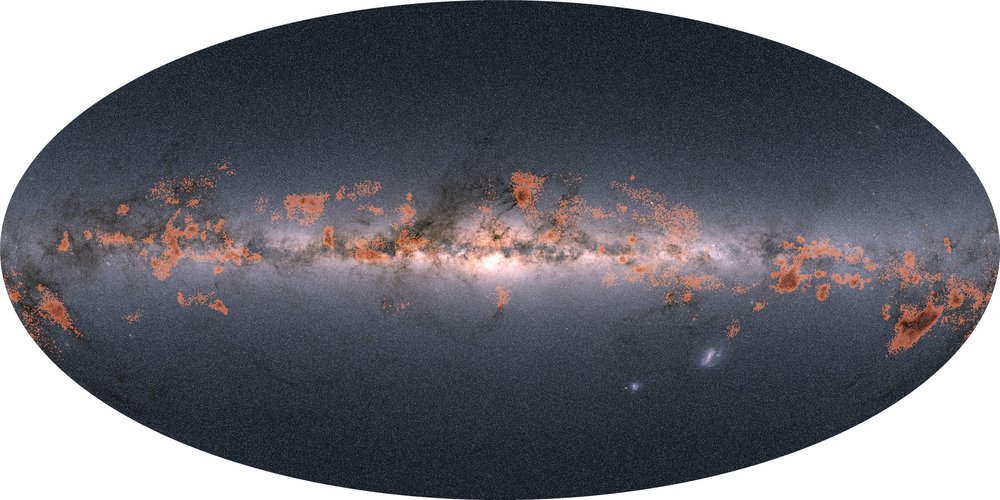
    Stellar families in Gaia’s sky

    In the past decade, the European Space Agency’s Gaia mission has revealed the nature, history, and behaviour of billions of stars. Our pioneering stargazer has reshaped our view of the skies around us like no other, revealing that star clusters are more connected than expected over vast distances.

  • NASA:
    Written by Conor Hayes, Graduate Student at York University Earth planning date: Friday, Aug. 22, 2025 Curiosity is continuing its winding path through the mysterious boxwork structures that have been a major focus of the last several months of the mission. After driving away from “Río Frío,” we are now parked on top of a […]
  • NASA:
    Titans Space Industries, a commercial space company, selected a new cohort of astronaut candidates this spring – and among them is NASA citizen scientist, Benedetta Facini. She has participated in not one, but many NASA citizen science projects: Cloudspotting on Mars, Active Asteroids, Daily Minor Planet, GLOBE, Exoasteroids and International Astronomical Collaboration (IASC). We asked […]
  • NASA:
    NASA’s X-59 quiet supersonic research aircraft sits on the ramp at sunrise before ground tests at Lockheed Martin’s Skunk Works facility in Palmdale, California, on July 18, 2025. Following completion of low-speed taxi tests in July 2025 in Palmdale, California, medium- and high-speed taxi tests mark the final steps before the aircraft takes to the skies for […]
  • NASA:
    A Washington state high school student with a passion for art, space exploration, and a curiosity about the possibility of life on other planets earned the grand prize for the 2025 NASA Student Art Contest. Dahyun Jung’s winning piece, titled “My Wonders with You,” shows a child seated on the roof of a barn, their […]