Hello,
This page will be updated.... Soon TM.
Hello,
This page will be updated.... Soon TM.
And now some aggregated RSS Feeds from major space agencys.
 Video:
00:00:48
On 28 September 2026, ESA’s Jupiter Icy Moons Explorer (Juice) successfully completed a gravity assist flyby of Earth. Flight controllers guided the spacecraft close to our home planet to increase its velocity by 3.5 km/s and deflect its trajectory by an angle of 20°.
As Juice flew just 8640 km above the Indian Ocean, it snapped a series of images with its onboard monitoring cameras, giving us a unique ‘Juice eye view’ of our home planet.
Juice’s monitoring cameras provide 1024 x 1024 pixel snapshots that can be processed in colour. Their main purpose is to monitor the spacecraft’s various booms and antennas, especially during the challenging period after launch. The photos they captured of Earth during the flyby are a bonus.
In the first seconds of the video we see a view from Juice monitoring camera 2 – or JMC2 – with Earth appearing as a thin crescent at the bottom right of the frame. Around 10 seconds in, we switch to a view from JMC1, with almost the entire disc of Earth visible at the top right of the frame. The large land mass that we see is Africa. Even the Moon is visible as a tiny grey dot to Earth’s right. At the very end of the video, JMC1 gives us a final view of Earth in the distance as it flies away on 29 September.

The European Space Agency (ESA) will participate in the 77th International Astronautical Congress (IAC), which opens on Monday 5 October and runs until Friday 9 October in Antalya, Türkiye. More than 6 000 participants are expected at the Nest Congress and Exhibition Centre, under the theme ‘The World Needs More Space’.
ESA will be present throughout the event in Hall 1, booth 1B-02, with an exhibition showcasing the agency’s latest mission results, achievements and future ambitions.
 Video:
00:03:32
September was a month of milestones and discoveries. FLEX launched aboard Vega-C alongside Sentinel-3C. Sophie Adenot completed her third and final spacewalk, leading the mission as EV-1. BepiColombo separated from its Mercury Transfer Module, taking another step towards Mercury. Spectrum became the first rocket to reach orbit from continental Europe. And the James Webb Space Telescope found tiny brown dwarfs that could harbor the building blocks of planets.
Here’s a look at what space had in store for Europe this September!

When Anak Krakatau erupted a few weeks ago, the European Space Agency’s EarthCARE satellite, orbiting above, captured vertical profiles of different constituents within the volcanic plume. Designed primarily to advance our understanding of how clouds and aerosols influence Earth’s climate, here EarthCARE also provided valuable information to support safe air travel.
At the same time, these observations offer new insights into the impact that volcanic eruptions have on the climate system.

On 23 September, the European-Chinese Smile mission was declared ready to start revealing how Earth responds to the wind of charged particles from the Sun. This follows a busy in-space commissioning period since the spacecraft launched on 19 May and reached its target orbit for science operations on 20 June.
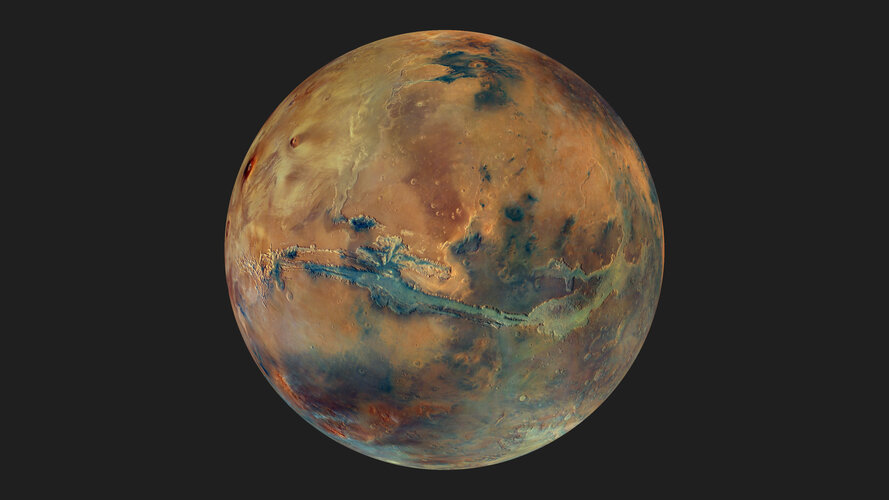
30 September 2026 marks the start of a new year on Mars. At exactly 13:43 CET/11:43 UTC on Earth, the Red Planet begins a new orbit around our Sun.
 Image:
This NASA/ESA/CSA James Webb Space Telescope Picture of the Month features galaxies in great detail that have been warped and multiplied like they’ve stepped into a house of mirrors. The brilliant golden galaxies splashed across this image belong to a galaxy cluster called MACS J0454.1-0300. The orange galaxies concentrated on one side of the cluster are not actually part of the cluster and are much farther away from us.
MACS J0454.1-0300 is itself immensely distant: the light from these galaxies has been travelling to us for so long that we’re seeing the cluster as it was when the Universe was about 8 billion years old. While this galaxy cluster is a valuable scientific target in its own right, the real stars of this image are the galaxies that appear warped and stretched, like a painting that has been smeared by a giant hand.
The way these galaxies look is the result of gravitational lensing, in which the enormous mass of a foreground object such as a galaxy cluster bends and magnifies the light from a more distant object in the background. Gravitational lensing allows astronomers to observe galaxies, star clusters and even individual stars that are too far away for our telescopes to see under normal conditions. While the large, orange galaxies appear obviously distorted, look carefully at some of the small reddish background galaxies throughout this picture: even at the very edges of the frame, there are galaxies whose images have been bent into tiny arcs by MACS J0454.1-0300’s gravity.
The gravitationally lensed areas show multiple images of galaxies from when the Universe was young: a group of galaxies 2 billion years after the Big Bang, and a single galaxy just 800 million years old after the Big Bang. The galaxy group appears to be going through a merger, resulting in an enormous burst of star formation.
Astronomers have also identified individual bright ‘knots’ within the gravitationally lensed areas, corresponding to regions as small as 5 light-years across. These tiny clumps appear magnified by a factor of more than 300, in some cases.
A NASA/ESA Hubble Space Telescope image of this same cluster was released in 2014. Take a moment to compare the two images; the difference between them is dramatic. The new Webb image reveals hundreds of galaxies missing from the earlier image. These galaxies were there all along, but Webb is much more sensitive to their much redder light.
The data behind this image come from two observing programmes (#5058, PI: Furtak; #6882, PI: Fujimoto) that leverage the ability of massive galaxy clusters to bring distant objects into view.
[Image Description: A massive galaxy cluster, made of many golden elliptical galaxies with the largest, brightest one in the centre. Heavily distorted orange galaxies appear all around the cluster, the largest concentrated in a large arc around the cluster's centre; these are images of very distant galaxies, created by gravitational lensing. A few galaxies are large and bluish-white in colour; bright, nearby stars are the same colour.]

The European Space Agency’s Jupiter Icy Moons Explorer (Juice) skimmed the very outer edge of Earth’s atmosphere on 28 September, using the gravity of our home planet to alter its route to Jupiter using very little fuel.

As we prepare to return to the Moon, Europe’s leading geology training for astronauts PANGAEA celebrates its 10th anniversary turning extraordinary places on Earth into classrooms for space exploration.