Hello,
This page will be updated.... Soon TM.
Hello,
This page will be updated.... Soon TM.
And now some aggregated RSS Feeds from major space agencys.

Better in-flight streaming and video-calling might just become more accessible thanks to a project supported by the European Space Agency (ESA). Building upon the success of an experiment for a new type of antenna terminal together with ESA, Viasat – a global leader in satellite communications – now plans to commercialise its new in-flight connectivity solution called Viasat Amara.

Are you ready to take your first step into the space sector? The countdown has begun for the launch of the European Space Agency's 2026 Student Internship Programme, and you could be part of it. Applications open the first week of November.

The new Copernicus Sentinel-4 mission has delivered its first images, highlighting concentrations of atmospheric nitrogen dioxide, sulphur dioxide and ozone. Despite being preliminary, these images mark a major milestone in Europe’s ability to monitor air quality all the way from geostationary orbit, 36 000 kilometres above Earth.

The launch campaign of the next satellite to join the Copernicus Sentinel-1 mission is progressing on schedule for launch on Tuesday, 4 November, on board an Ariane 6 rocket.

Week in images: 13-17 October 2025
Discover our week through the lens
Image:
The changing face of the Chilean glaciers in the Laguna San Rafael National Park is featured in these satellite images from 1987 and 2024.


The European Space Agency's presence in Spain is set to be strengthened, while more than a dozen contracts with Spanish industry were signed on Thursday.

No communication or navigation, faulty electronics and collision risk. At ESA’s mission control in Darmstadt, teams faced a scenario unlike any before: a solar storm of extreme magnitude. Fortunately, this nightmare unfolded not in reality, but as part of the simulation campaign for Sentinel-1D, pushing the boundaries of spacecraft operations and space weather preparedness.
 Video:
00:05:04
Video:
00:05:04
English ESA Open Day 2025: An Unforgettable Journey Through Space Science at ESAC
On 4 October 2025, the European Space Agency opened the doors of ESAC – the European Space Astronomy Centre near Madrid – for an inspiring day of discovery. Visitors had the opportunity to explore ESA’s window to the Universe, where missions studying our Solar System, the Milky Way and the distant Universe are operated and analysed.
Throughout the day, guests met ESA scientists and engineers, learned about missions such as Gaia, XMM-Newton, and JUICE, and experienced hands-on activities that brought the wonders of astrophysics and planetary science to life. Interactive exhibits, talks, and guided tours showcased how ESA’s science missions are expanding our understanding of the cosmos.
More than two thousand participants of all ages enjoyed an unforgettable day filled with curiosity, innovation, and a shared passion for exploring the Universe.
Spanish Día de Puertas Abiertas de la ESA 2025: Un viaje inolvidable por la ciencia espacial en ESAC
El 4 de octubre de 2025, la Agencia Espacial Europea (ESA) abrió las puertas de ESAC – el Centro Europeo de Astronomía Espacial, cerca de Madrid – para una jornada inspiradora dedicada al descubrimiento. Los visitantes tuvieron la oportunidad única de adentrarse en el corazón del programa científico de la Agencia Espacial Europea, la ventana de la ESA al Universo, donde se operan y analizan misiones que estudian nuestro Sistema Solar, la Vía Láctea y el espacio profundo.
Charlas, exposiciones y visitas guiadas mostraron cómo las misiones científicas de la ESA amplían nuestro conocimiento del cosmos. A lo largo del día, los asistentes pudieron conocer a científicos e ingenieros de la ESA, descubrir misiones como Gaia, XMM-Newton y JUICE, y participar en actividades interactivas que acercaron la astrofísica y la ciencia planetaria al público de todas las edades.
Más de dos mil personas disfrutaron de una jornada inolvidable y llena de curiosidad, innovación y pasión por explorar el Universo.
 Video:
00:01:33
Video:
00:01:33
Friday the 13th of April 2029 will be our lucky day.
Apophis, a 375-metre-wide asteroid, will safely pass Earth at a distance of less than 32 000 kilometres. For a few hours, Apophis will be closer than satellites in geostationary orbit and visible to the naked eye from Europe and Africa.
Space agencies have sent a number of spacecraft to asteroids, but we have never had a mission at an asteroid as it sweeps past a planet. This grand natural experiment offers a unique opportunity to study in real time how an asteroid responds to a strong external force – and the European Space Agency aims to have a front-row seat.
To this end, ESA’s Space Safety Programme has proposed the Rapid Apophis Mission for Space Safety (Ramses). If approved, Ramses would launch a year ahead of the Apophis flyby, travelling through space to rendezvous with the asteroid months before its encounter with Earth.
Ramses would use a suite of scientific instruments to measure Apophis’s size, shape, composition, rotation and trajectory as it is pulled and stretched by Earth’s gravity. It wouldalso deploy two smaller spacecraft at the asteroid to study Apophis up-close.
Apophis poses no danger to Earth during the flyby, but an asteroid of this size passes thisclose to our planet only once every roughly seven thousand years. By seizing this exceptionally rare opportunity to study an asteroid before, during, and after a planetary encounter, Ramses would help us prepare for the day that we may need to deflect a hazardous object on a collision course with Earth.
A cornerstone of the Planetary Defence segment of ESA’s Space Safety Programme, Ramses would demonstrate Europe’s ability to rapidly design, launch and operate a mission to an asteroid of high importance.
When the world looks up to see Apophis passing overhead, Ramses could be flying alongside, uncovering the secrets of the Solar System’s ancient building blocks, and helping us learn how to protect our planet from any that come too close for comfort.

Using 11 years of magnetic field measurements from the European Space Agency’s Swarm satellite constellation, scientists have discovered that the weak region in Earth’s magnetic field over the South Atlantic – known as the South Atlantic Anomaly – has expanded by an area nearly half the size of continental Europe since 2014.

Week in images: 06-10 October 2025
Discover our week through the lens
 Image:
This wide view of Copernicus Sentinel-3 shows Cyclone Errol heading towards the coast of Western Australia.
Image:
This wide view of Copernicus Sentinel-3 shows Cyclone Errol heading towards the coast of Western Australia.

By fitting its sunshield and solar panels, engineers have completed the construction of Plato, the European Space Agency’s mission to discover Earth-like exoplanets. Plato is on track for the final key tests to confirm that it is fit for launch.


During recent storms, satellites recorded ocean waves averaging nearly 20 metres high – the largest ever measured from space. Moreover, satellite data now reveal that ocean swells act as storm ‘messengers’: even though a storm may never make landfall, its swell can travel vast distances and bring destructive energy to distant coastlines.

The Copernicus Sentinel-1 mission is about to get its fourth satellite. Copernicus Sentinel-1D has now undergone the checks and functional tests prior to its integration with Ariane 6, ready for launch on Tuesday, 4 November 2025.

Between 1 and 7 October, ESA’s ExoMars Trace Gas Orbiter (TGO) and Mars Express spacecraft turned their eyes towards interstellar comet 3I/ATLAS, as it passed close to Mars.
 Video:
00:07:47
Video:
00:07:47
What a difference a year makes! Today Hera’s asteroid mission for planetary defence is cruising through deep space on the far side of the Sun, headed to its final destination: the Didymos binary asteroid system. But a year ago, on 7 October 2024, it was unsure if the mission was ever going to take off at all.
Its launcher was grounded due to a launch anomaly and Hurricane Milton was closing on Cape Canaveral! The mission needed to lift off then and there because it had to perform a flyby of Mars to speed it on its way to Didymos. Any delay would add years to its travel time. But Hera received permission for launch and the heavens cleared just half an hour before launch. Liftoff happened to plan – the team had their mission in space!
Since then Hera has been testing out the ‘self-driving’ technology it will use around the asteroids on Earth and the Moon, performed its flyby of Mars and imaged its very first asteroid from three million kilometres, proving the capability of its main Asteroid Framing Camera. Next Hera is heading for aphelion, its furthest distance from the Sun. It will reach Didymos in autumn 2026, after which it will begin its mission to find out what happened to the smaller asteroid after NASA’s DART spacecraft impacted it in September 2022.

Satellite navigation is essential to everything from tracking your morning jog to landing air ambulances. But as reliance on satellite navigation grows, so do the risks associated with its interruption, natural or intentional. In its pursuit of strengthening European resilience in navigation, the European Space Agency (ESA) took part in Jammertest.

The European Space Agency (ESA) has expanded its capability to communicate with scientific, exploration and space safety missions across our Solar System with the inauguration of a new 35-m diameter deep space antenna – the fourth for Estrack, ESA’s deep space tracking network.

Week in images: 29 September - 3 October 2025
Discover our week through the lens
 Video:
00:07:42
Video:
00:07:42
2025 marks a landmark year for Europe’s ‘bridge between Earth and space’. The European Space Agency’s Estrack satellite tracking network turns 50.
Since its inception in 1975, Estrack – ESA’s global network of ground stations – has formed the vital communication bridge between satellites in orbit and mission control at the European Space Operations Centre (ESOC) in Darmstadt, Germany.
Now comprising six stations spanning six countries, Estrack has grown into a strategic asset for Europe, enabling communication with spacecraft, transmitting commands and receiving scientific data.
The network keeps an eye on satellites no matter their location: tracking them across Earth orbit, voyaging to comets or asteroids, keeping station at the scientifically important Sun-Earth Lagrange points, and deep into our Solar System. It even keeps tabs on European launchers as they soar into orbit, ensuring no rocket is ever out of reach.
This year, ESA is also expanding its deep space communication capabilities with the construction of a new 35-metre deep space antenna – the fourth of its kind. It will be joining the existing one at New Norcia station, Australia, to help meet the Agency's fast increasing data download needs.
 Image:
This Copernicus Sentinel-2 image captures an active lava lake on the Kilauea volcano on Hawaii’s Big Island.
Image:
This Copernicus Sentinel-2 image captures an active lava lake on the Kilauea volcano on Hawaii’s Big Island.
 Video:
00:03:16
Video:
00:03:16
ESA’s Mars Express takes us on another mesmerising flight over curving channels carved by water, islands that have resisted erosion, and a maze of hilly terrain.
Central to the tour is a 1300 km-long outflow channel called Shalbatana Vallis. It cascades down from the highland region of Xanthe Terra to the smoother lowlands of Chryse Planitia.
Billions of years ago, water surged through this channel, creating many of the features we see today.
The tour culminates in a spectacular view of a 100 km-wide impact crater, smashed out of Mars’s surface when it collided with a space rock.
Enjoy the flight, and be sure to turn up the volume for the full audio guide experience.
Processing notes:
This film was created using the Mars Express High Resolution Stereo Camera Mars Chart (HMC30) data, an image mosaic made from single orbit observations of the mission’s High Resolution Stereo Camera (HRSC). The mosaic image, centred at 5°N/320°E, is combined with topography information from the digital terrain model to generate a three-dimensional landscape.
For every second of the movie, 50 separate frames are rendered following a predefined camera path in the scene. The vertical exaggeration used for the animation is three-fold. Atmospheric effects, like clouds and haze, have been added to conceal the limits of the terrain model. The haze starts building up at a distance of 250 km.
The HRSC camera on Mars Express is operated by the German Aerospace Center (DLR). The systematic processing of the camera data took place at the DLR Institute for Planetary Research in Berlin-Adlershof. The working group of Planetary Science and Remote Sensing at Freie Universität Berlin used the data to create the film.

The European Space Agency and the Korea AeroSpace Administration (KASA) have announced they will work together on peaceful uses of space, starting with space weather monitoring and sharing space communications facilities.

The European Space Agency (ESA) has signed a €50 million contract with aerospace company Thales Alenia Space to begin the preliminary design phase of the Security And cryptoGrAphic (SAGA) mission. This agreement enables SAGA to continue to its preliminary design review, marking a relevant step towards establishing secure, space-based communications using quantum technologies.

Following its arrival in California a few weeks ago, the time has come for spacecraft engineers to ready the next sea-level monitoring satellite, Copernicus Sentinel-6B, for launch, which is slated for November.
The first step has been to carefully remove this precious new satellite from its storage container and to start a series of comprehensive checks.

The third day of the 76th International Astronautical Congress was again full of interactions between the European Space Agency and international partners.
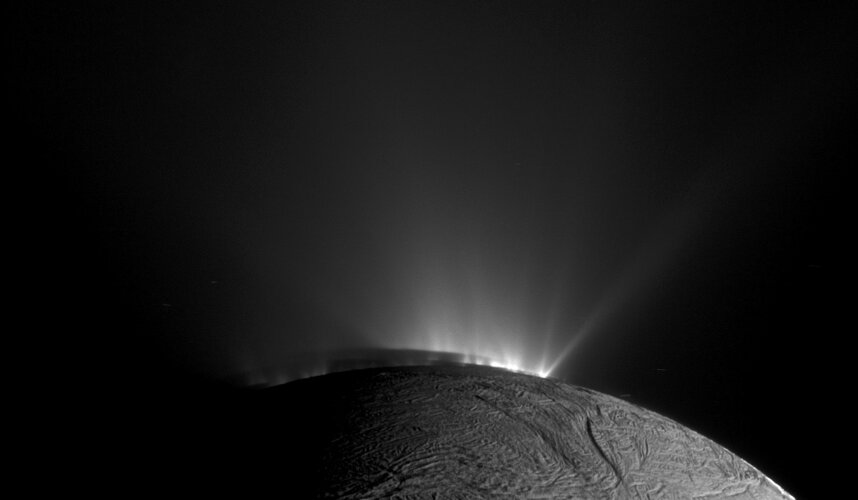
Scientists digging through data collected by the Cassini spacecraft have found new complex organic molecules spewing from Saturn’s moon Enceladus. This is a clear sign that complex chemical reactions are taking place within its underground ocean. Some of these reactions could be part of chains that lead to even more complex, potentially biologically relevant molecules.
Published today in Nature Astronomy, this discovery further strengthens the case for a dedicated European Space Agency (ESA) mission to orbit and land on Enceladus.