Space and Mineral Mining Information

Hello,

This page will be updated.... Soon TM.

And now some aggregated RSS Feeds from major space agencys.
News

  • JAXA:
    setTimeout("redirect()", 3); function redirect(){ location.href='https://www.jaxa.jp/press/
  • NASA:
    Now in its 26th year, the event brings teams of middle and high school students to the lab to compete with home-built contraptions. Teenagers wielding power tools and plywood demonstrated their engineering prowess at the annual Invention Challenge at NASA’s Jet Propulsion Laboratory in Southern California on Friday. Also in evidence: lots of small motors, […]
  • NASA:
    NASA’s broadcast of the April 8, 2024, total solar eclipse has won an Emmy Award for Excellence in Production Technology. At the 76th Technology & Engineering Emmy Awards on Dec. 4, in New York City, the Academy of Television Arts & Sciences announced the win. Walt Lindblom and Sami Aziz accepted the award on behalf […]
  • NASA:
    Researchers from NASA’s Jet Propulsion Laboratory monitor a research drone in this September 2025 photo. This flight occurred in Dumont Dunes, an area of the Mojave Desert, as part of a larger test campaign to develop navigation software that would guide future rotorcraft on Mars. The work was among 25 projects funded by NASA’s Mars […]
  • ESA:
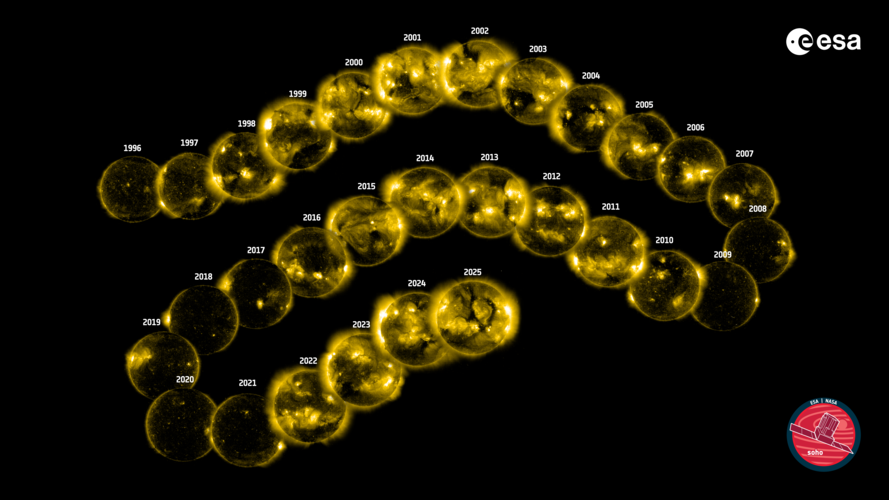
    30 years of SOHO imaging the Sun

    Week in images: 01-05 December 2025

    Discover our week through the lens

  • NASA:
    This NASA/ESA Hubble Space Telescope image features a stormy and highly active spiral galaxy named NGC 1792. Located over 50 million light-years from Earth in the constellation Columba (the Dove), the bright glow of the galaxy’s center is offset by the flocculent and sparkling spiral arms swirling around it. NGC 1792 is just as fascinating […]
  • ESA:
    This Copernicus Sentinel-1 image features part of the Badain Jaran Desert in northwestern China. Image: This Copernicus Sentinel-1 image features part of the Badain Jaran Desert in northwestern China.
  • NASA:
    A rare tropical cyclone dropped torrential rains on the Indonesian island, fueling extensive and destructive floods.
  • NASA:
    NASA has selected two science instruments designed for astronauts to deploy on the surface of the Moon during the Artemis IV mission to the lunar south polar region. The instruments will improve our knowledge of the lunar environment to support NASA’s further exploration of the Moon and beyond to Mars.  “The Apollo Era taught us that […]
  • NASA:
    Two technicians look up at NASA’s Nancy Grace Roman Space Telescope after its inner and outer segments were connected at the agency’s Goddard Space Flight Center in Greenbelt, Maryland on Nov. 25, 2025. This marked the end of Roman’s construction. After final testing, the telescope will move to the launch site at NASA’s Kennedy Space […]
  • NASA:
    NASA astronaut Jonny Kim, accompanied by Roscosmos cosmonauts Sergey Ryzhikov and Alexey Zubritsky, is preparing to depart the International Space Station aboard the Soyuz MS-27 spacecraft and return to Earth. Kim, Ryzhikov, and Zubritsky will undock from the station’s Prichal module at 8:41 p.m. EST on Monday, Dec. 8, headed for a parachute-assisted landing at […]
  • NASA:
    For the first time, scientists have made a clear X-ray detection of chlorine and potassium in the wreckage of a star using data from the Japan-led XRISM (X-ray Imaging and Spectroscopy Mission) spacecraft. The Resolve instrument aboard XRISM, pronounced “crism,” discovered these elements in a supernova remnant called Cassiopeia A or Cas A, for short. […]
  • NASA:
    When flying in certain weather conditions, tiny freezing water droplets floating in the air can pose a risk to aircraft. If not taken into consideration, these water droplets can accumulate on an aircraft as ice and pose a safety risk.  But NASA software tools such as Glenn Icing Computational Environment (GlennICE) are working to keep […]
  • ESA:
    Comet 3I/ATLAS shows activity in Juice navigation camera teaser Image: Comet 3I/ATLAS shows activity in Juice navigation camera teaser
  • NASA:
    NASA’s next big eye on the cosmos is now fully assembled. On Nov. 25, technicians joined the inner and outer portions of the Nancy Grace Roman Space Telescope in the largest clean room at the agency’s Goddard Space Flight Center in Greenbelt, Maryland. “Completing the Roman observatory brings us to a defining moment for the […]
  • DLR:
    Am vergangenen Wochenende sind am östlichen Sonnenhorizont mehrere besonders aktive Sonnenfleckenregionen erschienen. Zusammengenommen erreichen sie eine Größe, die mit der jener Sonnenfleckenregion vergleichbar ist, die der britische Astronom Richard Carrington am 1. September 1859 beobachtete und die zum stärksten Sonnensturm der letzten Jahrhunderte führte. Das DLR beobachtet die Situation mit besonderer Aufmerksamkeit. Änderungen in der Sonnenaktivität und mögliche Auswirkungen auf das Weltraumwetter werden in Echtzeit analysiert, um Frühwarnungen und nötige Schutzmaßnahmen rechtzeitig zu ermöglichen.
  • NASA:
    In its first documented eruption, the Ethiopian volcano sent a plume of gas and ash drifting across continents.
  • NASA:
    The NASA Science Activation project Eclipse Soundscapes (ES), led by ARISA Lab in Medford, Massachusetts, helps learners of all ages explore NASA science through multisensory learning and participatory science opportunities. In the weeks surrounding the 2023 annular solar eclipse and the 2024 total solar eclipse, Eclipse Soundscapes invited volunteer Data Collectors to use AudioMoth acoustic […]
  • NASA:
    Select walls at NASA’s Johnson Space Center have been transformed into works of art. Each piece reflects creativity, collaboration, and the spirit of discovery. Painted by Texas students, the murals honor the legacy of the International Space Station and 25 years of continuous human presence in space.  The International Space Station Program Mural Project began […]
  • NASA:
    Perseverance confirmed a long-suspected phenomenon in which electrical discharges and their associated shock waves can be born within Red Planet mini-twisters. NASA’s Perseverance Mars rover has recorded the sounds of electrical discharges —sparks — and mini-sonic booms in dust devils on Mars. Long theorized, the phenomenon has now been confirmed through audio and electromagnetic recordings […]
  • NASA:
    This NASA/ESA Hubble Space Telescope image features the spiral galaxy NGC 4535, which is situated about 50 million light-years away in the constellation Virgo (the Maiden). Through a small telescope, this galaxy appears extremely faint, giving it the nickname ‘Lost Galaxy’. With a mirror spanning nearly eight feet (2.4 meters) across and its location above Earth’s light-obscuring […]
  • DLR:
    Am 23. November brach überraschend der Vulkan Hayli Gubbi in Äthiopien aus — die erste bekannte Eruption seit dem Ende der letzten Eiszeit. Daten aus dem Projekt INPULS erlauben, die vulkanischen Emissionen zu verfolgen.
  • NASA:
    Hazardous Materials Summary Tables (HMSTs) are a compilation of the chemical, biological, and flammability hazards of materials on a given flight or mission. HMSTs are required by Safety for all Programs, including but not limited to ISS, Commercial Crew Program (CCP), Multi Purpose Crew Vehicle (MPCV), and Gateway. Johnson Space Center (JSC) toxicologists evaluate the […]
  • NASA:
    Toxicology and Environmental Chemistry (TEC) monitors airborne contaminants in both spacecraft air and water. In-flight monitors are employed to provide real-time insight into the environmental conditions on ISS. Archival samples are collected and returned to Earth for full characterization of ISS air and water. Real-time in-flight air analytical instruments include the Air Quality Monitors (AQM), […]
  • ESA:
    EarthCARE improves estimates of how clouds influence Earth’s energy balance

    True to its promise, the European Space Agency’s EarthCARE satellite is now being used to calculate directly how clouds and aerosols influence Earth’s energy balance – the all-important balance that regulates our climate. In doing so, EarthCARE is poised to sharpen the accuracy of climate models, the very tools that guide global climate policy and action.

  • ESA:
    Bird’s-eye view: the butterflies and dark layers of Idaeus Fossae

    Is it an insect? A strange fossil? An otherworldly eye, or even a walnut? No, it’s an intriguing kind of martian butterfly spotted by ESA’s Mars Express.

  • DLR:
    Mit der Gründung des DLR-Instituts für Frontier Materials auf der Erde und im Weltraum bündelt das DLR seine Kompetenzen in der Materialforschung. Dadurch öffnet sich ein neues Kapitel in der Entwicklung zukunftsweisender Werkstoffe und Herstellungsprozesse - auf der Erde und im All. Das Institut verbindet Exzellenz in der anwendungsnahen Forschung mit gesellschaftlicher Relevanz und schafft durch Innovation langfristige technologische Perspektiven. Geleitet wird es von Prof. Dr.-Ing. Daniela Zander und Prof. Dr. Guillermo Requena.
  • DLR:
    Neue Motive der DLR-Marskamera HRSC zeigen ein Gebiet zwischen der Hochlandregion Tempe Terra und der Tieflandebene Acidalia Planitia. Im Bild dominiert überwiegend flaches Gelände mit einigen dunkel umrissenen Tafelbergen und einem ungewöhnlich aussehenden Einschlagskrater. 1976 setzte das Viking-Landevehikel im Westen dieser Ebene auf.
  • DLR:
    Der Himmel über Gabun in Zentralafrika war in den vergangenen Wochen Schauplatz einer besonderen Allianz: Ein Forschungsflugzeug des DLR erstellte Radaraufnahmen des Regenwalds – in Flugbahnen simultan zum Erdbeobachtungssatelliten Biomass der Europäischen Weltraumorganisation (ESA). Die Messflüge der DO 228-212 D-CFFU wurden exakt auf die Überflüge des neuen Satelliten abgestimmt.
  • JAXA:
     The launch of MICHIBIKI No. 5, Quasi-Zenith Satellite System (QZS-5) aboard the 8th H3 Launch
  • NASA:
    NASA astronaut Jonny Kim is wrapping up his first mission aboard the International Space Station in early December. During his stay, Kim conducted scientific experiments and technology demonstrations to benefit humanity on Earth and advance NASA’s Artemis campaign in preparation for future human missions to Mars. Here is a look at some of the science […]
  • NASA:
    NASA has selected the University of Alabama at Birmingham to provide the necessary systems required to return temperature sensitive science payloads to Earth from the Moon. The Lunar Freezer System contract is an indefinite-delivery/indefinite-quantity award with cost-plus-fixed-fee delivery orders. The contract begins Thursday, Dec. 4, with a 66-month base period along with two optional periods […]
  • NASA:
    NASA and industry partners will fly and operate a commercial robotic arm in low Earth orbit through the Fly Foundational Robots mission set to launch in late 2027. This mission aims to revolutionize in-space operations, a critical capability for sustainably living and working on other planets. By enabling this technology demonstration, NASA is fostering the […]
  • NASA:
    The waxing gibbous moon rises above Earth’s blue atmosphere in this photograph taken from the International Space Station on Oct. 3, 2025, as it orbited 263 miles above a cloudy Atlantic Ocean off the coast of Quebec, Canada. In our entire solar system, the only object that shines with its own light is the Sun. […]
  • NASA:
    Next-generation drone flight software is just one of 25 technologies for the Red Planet that the space agency funded for development this year. When NASA engineers want to test a concept for exploring the Red Planet, they have to find ways to create Mars-like conditions here on Earth. Then they test, tinker, and repeat.  That’s […]
  • NASA:
    NASA is marking America’s 250th year with a bold new symbol of the nation’s relentless drive to explore. The America 250 emblem is now on the twin solid rocket boosters of the SLS (Space Launch System) rocket for Artemis II — the powerhouse that will launch a crew of four around the Moon next year. […]
  • NASA:
    The asteroid Bennu continues to provide new clues to scientists’ biggest questions about the formation of the early solar system and the origins of life. As part of the ongoing study of pristine samples delivered to Earth by NASA’s OSIRIS-REx (Origins, Spectral Interpretation, Resource Identification, and Security-Regolith Explorer) spacecraft, three new papers published Tuesday by […]
  • NASA:
    On Nov. 2, 2025, NASA honored 25 years of continuous human presence aboard the International Space Station. What began as a fragile framework of modules has evolved into a springboard for international cooperation, advanced scientific research and technology demonstrations, the development of a low Earth orbit economy, and NASA’s next great leaps in exploration, including […]
  • DLR:
    Die Arktis ist eines der am wenigsten vom Menschen erschlossenen Gebiete der Erde – gleichzeitig sind die Veränderungen durch die globale Erwärmung hier so deutlich zu spüren wie in keiner anderen Region. Seit Jahren nimmt die Meereisbedeckung ab und das vorhandene Eis wird dünner. Das DLR hat einen neuen Algorithmus entwickelt, der Radarsatellitenaufnahmen der europäischen Sentinel-1 Mission und Höhenprofilmessungen des NASA-Satelliten ICESat-2 kombiniert, und so erstmals eine hochaufgelöste Berechnung der Eisdicke ermöglicht.
  • ESA:
    30 years of SOHO imaging the Sun (unannotated)

    On 2 December 1995 the ESA/NASA Solar and Heliospheric Observatory (SOHO) blasted into space – on what was supposed to be a two-year mission. 

    From its outpost 1.5 million km away from Earth in the direction of the Sun, SOHO enjoys uninterrupted views of our star. It has provided a nearly continuous record of our Sun’s activity for close to three 11-year-long solar cycles

  • JAXA:
    setTimeout("redirect()", 3); function redirect(){ location.href='https://www.jaxa.jp/press/
  • NASA:
    This article is for students grades 5-8. What is AI? Artificial intelligence, or AI, is a type of technology that helps machines and computers have “thinking” abilities similar to humans. Devices using AI can learn words and concepts, recognize objects, see patterns, or make predictions. They can also be taught how to work autonomously. AI […]
  • NASA:
    The Mid-Infrared Instrument (MIRI) on NASA’s James Webb Space Telescope captured glowing cosmic dust heated by very young massive stars in unprecedented detail in this image of the Sagittarius B2 (Sgr B2) molecular cloud released on Sept. 24, 2025. Sgr B2 is the most massive, and active star-forming region in our galaxy, located only a […]
  • ESA:
    Puttalam district in North Western Sri Lanka is currently facing severe flooding, landslides and rockfalls, caused by heavy monsoon rains across the region. Copernicus Sentinel-2 captured an image over the region yesterday, 30 November 2025, as well an image one month ago, showing the extent of flooding. Image: Puttalam district in North Western Sri Lanka is currently facing severe flooding, landslides and rockfalls, caused by heavy monsoon rains across the region. Copernicus Sentinel-2 captured an image over the region yesterday, 30 November 2025, as well an image one month ago, showing the extent of flooding.
  • DLR:
    Mit tiefer Trauer nehmen wir Abschied von Univ.-Prof. Dr. med. Rupert Gerzer, der am 23. November 2025 im Alter von 75 Jahren verstorben ist. Als langjähriger Direktor des DLR‑Instituts für Luft- und Raumfahrtmedizin (1992–2015) und als visionärer Gründer der luft- und raumfahrtmedizinischen Forschungsanlage :envihab hat er das Profil unserer Forschung entscheidend geprägt und die Möglichkeiten für die heutige wissenschaftliche Arbeit geschaffen. Mit seinem Tod verliert die Luft- und Raumfahrtmedizin in Deutschland, Europa und weltweit einen herausragenden Wissenschaftler, Förderer und Wegbereiter.
  • NASA:
    For more than 25 years, Mark Elder has helped make human spaceflight safe and possible. As the International Space Station EVA hardware manager in the Extravehicular Activity (EVA) Office within the EVA and Human Surface Mobility Program, he leads the team responsible for the spacesuits, tools, and logistics that keep astronauts protected during spacewalks—and ensures […]
  • DLR:
    Er wiegt nur sechs Kilogramm und ist so groß wie ein Schuhkarton – aber sein Inneres macht ihn zu einem Beobachter der Weltmeere: Der Kleinsatellit OTTER ist ins Weltall gestartet. In einer Höhe von 500 Kilometern klappt er seine Solarpaneele aus und startet seine Instrumente. Die Mission OTTER wird vom DLR gemeinsam mit Beteiligten aus der Industrie geplant und durchgeführt.
  • DLR:
    100 Tage in einer beengten Umgebung, ohne Freunde und Familie, mit strengen Regeln, in einem kleinen Team und abgeschottet von der Außenwelt – was macht das alles mit uns Menschen? Darum geht es bei der Isolationsstudie SOLIS100, die das DLR ab dem kommenden Frühjahr in Köln durchführt. Parallel können sich Interessierte für die nächste Bettruhestudie SMC3 im DLR bewerben.
  • ESA:

    ESA Discovery and Preparation has launched a new podcast series highlighting the innovative space technologies being developed through its activities.

  • DLR:
    Am 28. November 2025 ist die neu entwickelte Satellitenplattform GENA (GEnerischer flexibler NAno-Satellit) des Münchener Unternehmens OroraTech an Bord des SpaceX Transporter-15 ins All gestartet. GENA ist eine standardisierte, kommerzielle Nanosatelliten-Plattform, mit dem Ziel Experimente und Technologien von Kunden schnell und kostengünstig in den Orbit zu bringen. Die Deutsche Raumfahrtagentur im DLR hat die Entwicklung von GENA mit Mitteln des Bundes anteilig gefördert.